Origin & Grade
Filled or Unfilled: What the Difference Costs You
It is the same block, cut and processed differently, and the choice changes the appearance, the maintenance regime and the price. Buyers pay for filled material without being told what the filling did.
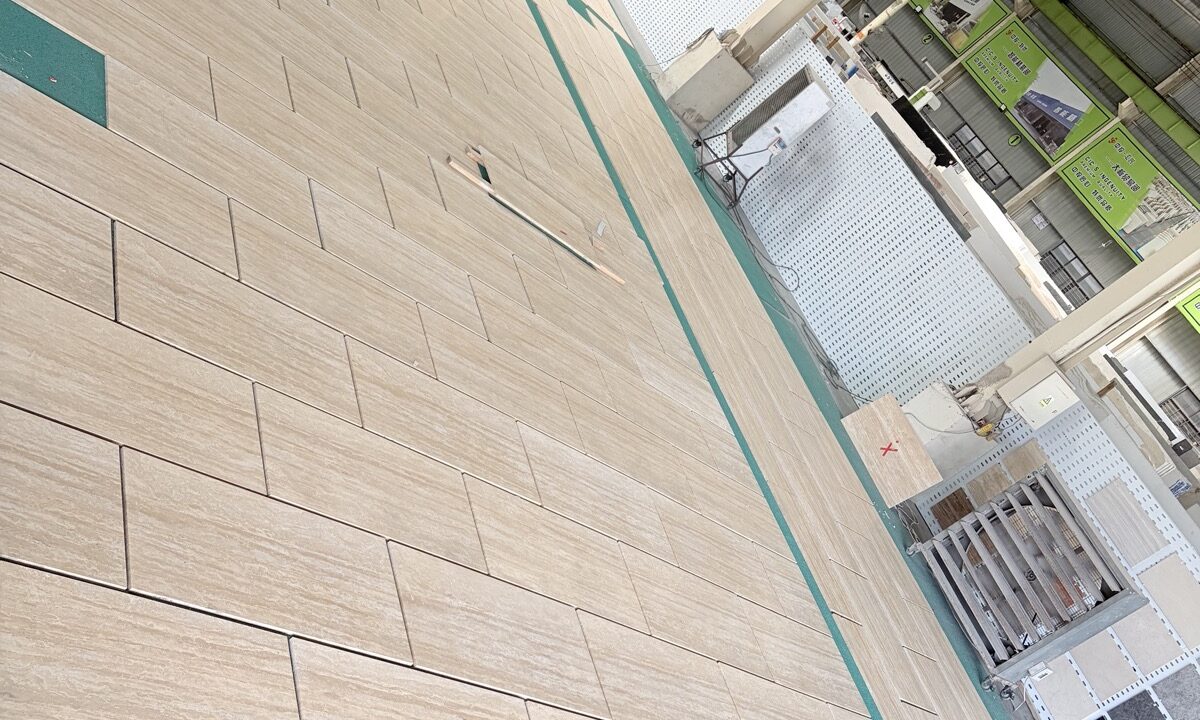
Every travertine order is really two orders: a block, and a decision about what to do to it. That second decision is invisible on a quotation line and visible on the invoice, so it is worth making deliberately rather than by default.
What the two products are
Unfilled travertine is the block as cut and finished. Its voids are open, its surface takes a honed or brushed finish with visible texture, and it absorbs water into its own structure. Filled travertine has resin or cement filler applied to the surface and drawn into the voids, cured, then ground back and re-finished. The finished piece is denser at the surface, takes a more consistent polish, and absorbs far less. Published absorption for unfilled travertine is commonly given as roughly 3-8% by weight; the equivalent figure for filled and honed material is under 1%.
What the filling actually changes
Three things, and only three, matter commercially.
Water behaviour. Filled material does not take a spill into its structure. On a worktop or a bathroom floor that is the difference between wiping and replacing.
Appearance. This is the cost. The voids that give unfilled travertine its character are no longer visible as voids. Filled travertine reads flatter, more even in tone, and more ordinary. Anyone who values the open, cloudier look is paying for it with the filling, and should be told that is what they are buying.
Finish quality. Filled material holds a high polish and a crisp arris because the filler levels the surface before polishing. Unfilled polished travertine has a broken sheen, because the polish sits differently on the voids than on the matrix. Neither is a defect. They are two finishes and they suit different rooms.
What it should never be
Filling is not a repair and it is not a substitute for a stable block. Quality filling on an unstable block produces a surface that fails with the block. It is also not a way of selling poor material as good: any supplier willing to fill is better served by filling properly and saying so than by filling badly and staying quiet.
The honest concern that buyers raise is the filler colour. Dark filler is visible in open voids from certain angles, particularly on honed surfaces under raking light. It is a real issue and it is manageable — filler is chosen to suit the colour of the stone — but it should be agreed before the order rather than discovered after delivery.
The position rule
The trade guidance that we apply internally, and that appears in most installer documentation, is consistent: travertine in a permanently wet position is filled. That covers shower enclosures, bathroom floors, pool surrounds, pool copings, outdoor terraces and anything in splash zones. Dry interiors — wall cladding, feature panels, a fireplace surround, a dry wall in a hallway — are better unfilled, because filling costs appearance and money for no functional gain.
There is no argument for polished travertine outdoors whatever its fill state. A polished surface is a slip hazard when wet, and it deteriorates faster through freeze-thaw cycles than a textured one. If travertine goes outside, it goes out honed, brushed or textured.
Four questions worth asking on any quotation
- Is this order filled or unfilled, and by what?
- If filled, is the filler colour matched to the stone, and can I see a sample?
- What is the stated absorption figure for the finished product, not just the raw material?
- Given the position this is going into, is this the right fill state, or am I paying for filling I do not need?
That last one is the one that saves money. A buyer who specifies filled material for a dry feature wall has paid for resin and grinding and received a flatter stone. It is not a bad outcome, but it was not a necessary one, and nobody was in a position to point it out except the supplier.
Sources: absorption ranges as published in stone product literature; fill and finish guidance consistent with installer and fabricator documentation. Appearance descriptions are the author’s own characterisation of the two finishes and are not a laboratory result.
Questions this article answers
Which country does my travertine come from?
We buy from seven: Turkey, Iran, Italy, Spain, Mexico, Pakistan and China, and they are not variants of one product. Turkish and Iranian material is strongly bedded and openly porous, which is what takes the classic vein-cut face. Italian and Spanish material is pale and fine-pored enough to take a high polish. Pakistani material is widely traded under this name and is mostly reef limestone, a different rock entirely. Chinese material covers several provinces that differ from each other as much as the countries do. They saw at different rates and take different fillers, so a quote that names no origin cannot be compared with another quote. We state the origin before we state a price, and we cut and finish all of it at our own base.
How is your travertine graded?
On what actually varies in the material rather than on a colour name. The grading question for travertine is how open the voids are, how deep they run, how regular they are, and whether the tone holds across the lot -- plus, where it matters, which producing region it came from and whether it is filled. A colour name carries none of that information, which is why two lots sold under the same name can arrive as visibly different stone.
Filed under Origin & Grade