T Travertine
Core Sourcing Agent for Travertine

Travertine

Travertine is graded by fill and by origin, not by colour. Turkish, Iranian and Pakistani material is strongly bedded and openly porous; Italian and Spanish material is pale and fine-pored enough to take a high polish; Chinese material covers several provinces that differ from each other as much as the countries do. Two lots sold under the same trade colour name can arrive as visibly different material. Tell us the origin, the fill and the format, and we will show you what actually comes out of the block.

7
quarry origins we buy from, Turkish and Iranian through to Italian, Pakistani and Chinese
2
fills, specified either way: cement or resin filled, and unfilled
3-8%%
water absorption by weight, published range for unfilled stone
34
product forms, from raw block to finished tables, cut and finished to order in Shuitou rather than supplied as they arrive
What decides a travertine order

Six questions come up before almost every travertine enquiry, and each one has a wrong answer that only shows up after the stone has been cut. They are worth settling before the order, not after.
How we work →
01 Fill

Filled or unfilled is the first decision, not the last

Unfilled travertine keeps its natural voids and reads lighter and more open. Filled travertine packs those voids with cement or resin and re-polishes, which produces a smoother, slightly darker and far more repeatable surface. The same base colour filled and unfilled are not two finishes of one material; they are two materials sharing a name, and they differ in price, in weight and in how they take a sealant. Specify it at the order, because it cannot be changed afterwards without cutting the material again.

02 Bedding

The bedding plane decides which face you see

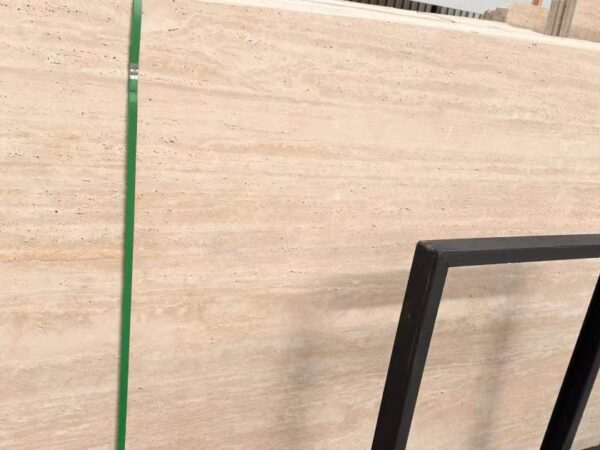
Travertine forms in layers, and the face cut across those layers shows the open linear structure everyone calls travertine. Cut parallel to them and you get a much finer, quieter surface. The choice is made at the saw, from the block, and it determines whether the wall panel in your photograph has visible horizontal movement or reads as plain cream. Ask which face has been cut before you approve the slab, not after.

03 Origin

Travertine is world-traded, and origin is not a formality

Turkish, Iranian and Pakistani material is the strongly bedded open-vein stone that most people picture, and it cuts across the bedding into the classic face. Italian and Spanish material is pale and fine-pored, denser, and takes the high polish that open-vein stone will not. Chinese material covers several provinces whose stone behaves differently on the saw and in the filler. They are not variations of one product under different trade names; they saw at different rates, take different filler and finish differently. A quote that names no origin is not a quote you can compare against another quote.

04 The voids

Open pores are the material, and a defect is not the same thing

The holes in travertine are how the stone formed -- calcite precipitating around spring water leaves them behind. They are a geological feature, and a slab with them is a normal slab. What distinguishes good from poor is the size, the regularity and the depth of the voids, and whether they run through the slab or sit near the face. On an unfilled outdoor piece, deep voids at the edges can spall; that is a real defect and it is worth inspecting for.

05 Use

Where it goes decides fill, finish and thickness together

Indoors, filled and honed holds colour and takes a mop. Outdoors, unfilled and honed or brushed, because a filled surface outdoors eventually blisters where the fill sits proud of the worn face. On a shower floor or a pool surround you need a measured slip rating, and travertine varies enough across a single lot that the rating belongs to the specific tile you bought, not to the material in general. Get these three wrong and no quality of stone rescues the job.

06 Yield

How much a block gives you is a bedding question

Travertine is quarried in blocks like any stone, but the yield depends entirely on how the bedding sits in that particular block. A well-chosen block can give long vein-matched wall runs; a badly chosen one gives short, mismatched pieces and a much higher waste figure. Anyone quoting you square metres for panels should be able to tell you which block the panels come out of. If they cannot, they are quoting the material and not the block.

What we cut

Every format below comes out of the same blocks, but the bedding plane decides which formats a given block is actually good for. Tell us the application and we will tell you which format the stone wants to be.
Browse all products →
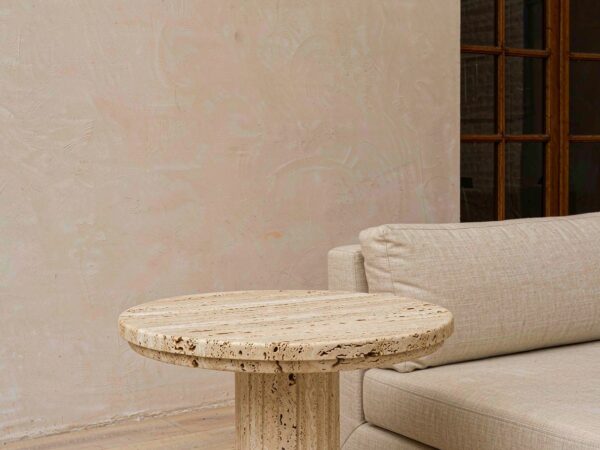
A round travertine side table on a single turned stone column
Travertine Side Table

Travertine Side Table

Honed
Indicative FOB: quoted per piece against the top size, the base and whether the top has to be cut from the same slab as the piece it matches. Matching is quoted as its own line rather than absorbed, because cutting a matching top competes for slab that the larger piece in the set may need.View →
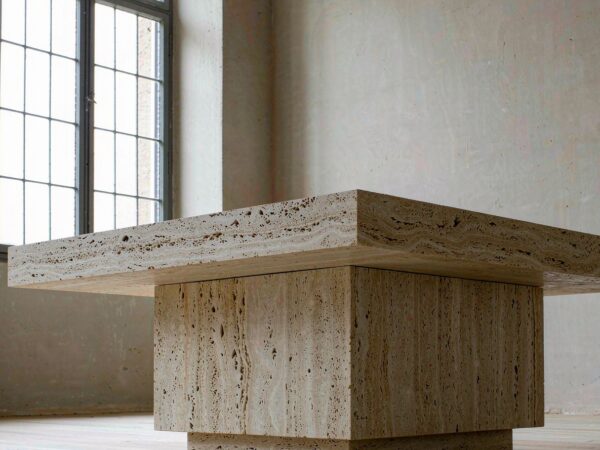
A travertine coffee table with a thick top on a recessed plinth base
Travertine Coffee Table

Travertine Coffee Table

Honed
Indicative FOB: quoted per piece against the top size and the base type. A recessed plinth and a full slab leg are different fabrications at an identical top, because the plinth has to support the top along a full perimeter frame rather than at four points.View →
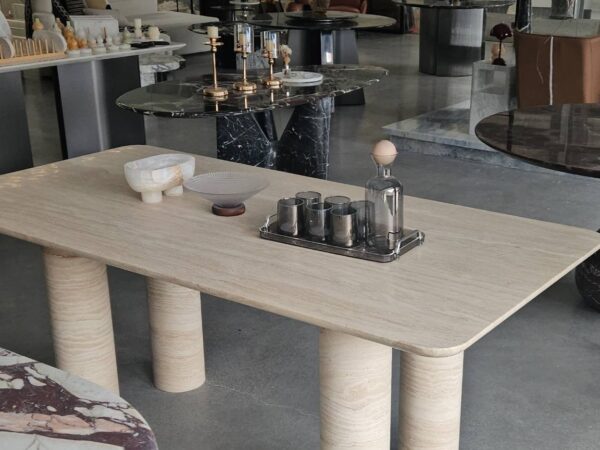
An unfilled travertine dining table with turned solid stone legs
Travertine Dining Table

Travertine Dining Table

Brushed
Indicative FOB: quoted per piece against the plan size, the top thickness and the leg construction. Legs are the larger half of the cost on this piece -- turned solid columns, panel-clad or a clad steel frame are three different products at the same top size, and the span decides which of them the top can carry.View →
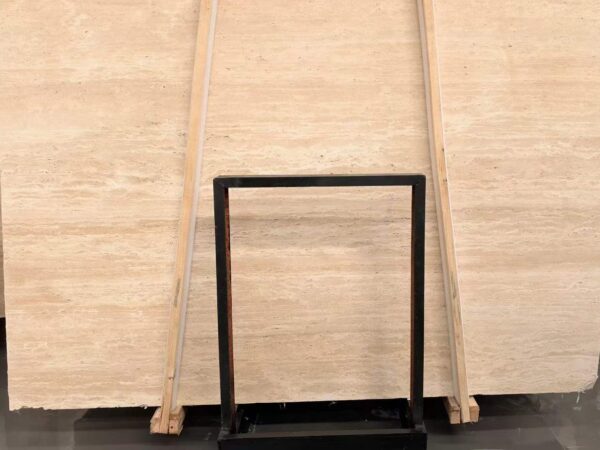
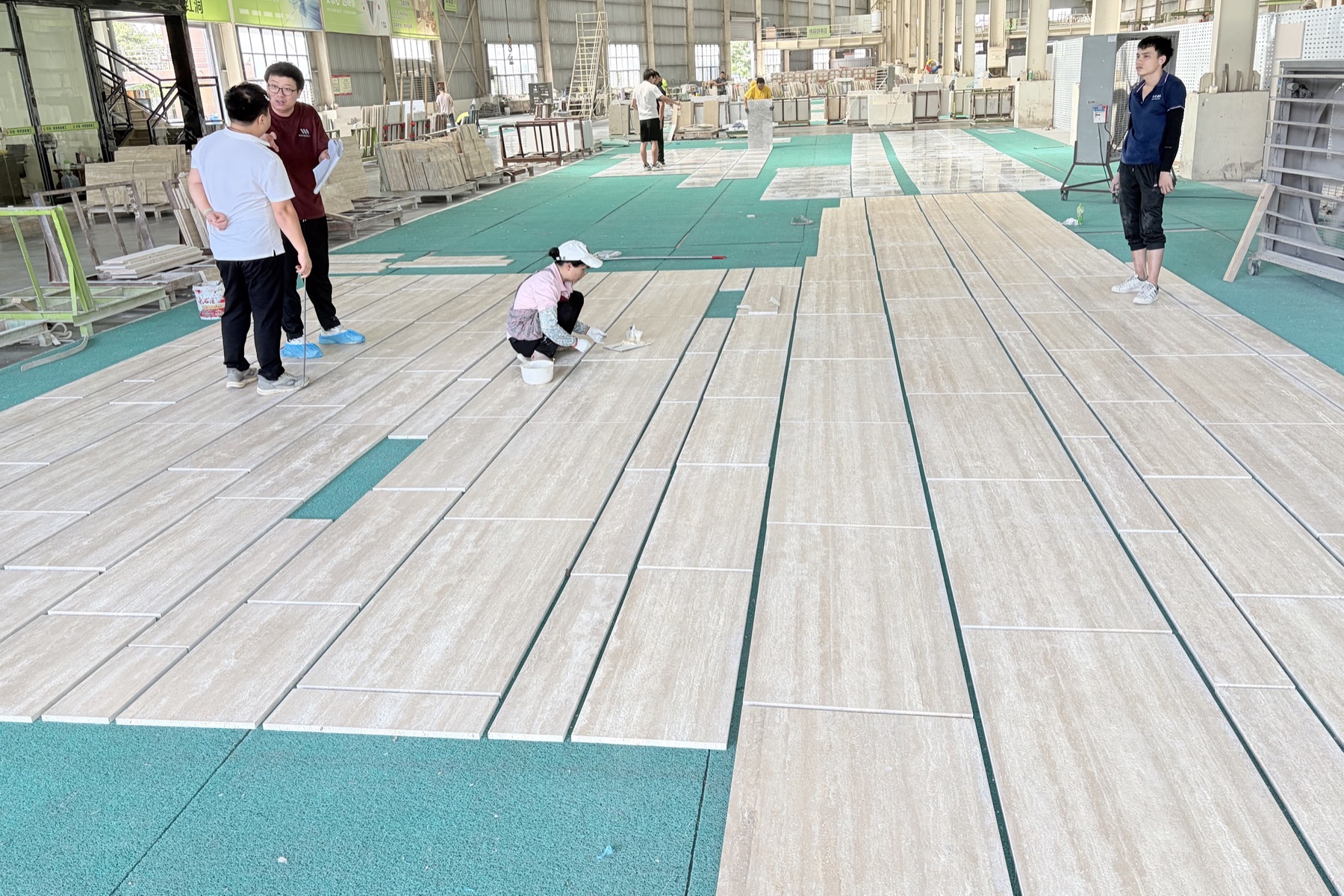
A single travertine slab standing on a steel frame, showing clear horizontal bedding across its face
Slab Cut to Order

Travertine Slab Cut to Order

Brushed
Indicative FOB: quoted per slab against nominal size, thickness and how many slabs are wanted from one block. Ordering a run from a single block is the cheapest way to get a matched wall; mixing across blocks is quoted separately because the tone will differ.View →
Rows of travertine slabs stored upright on timber racks, the cut faces toward the viewer
Half Block

Travertine Half Block

Split
Indicative FOB: quoted per piece against weight and cut-face count. Half blocks carry one sawn face rather than five, so the price is a fraction of the whole block -- but a buyer needing four faces usually wants the whole block and should be told so.View →
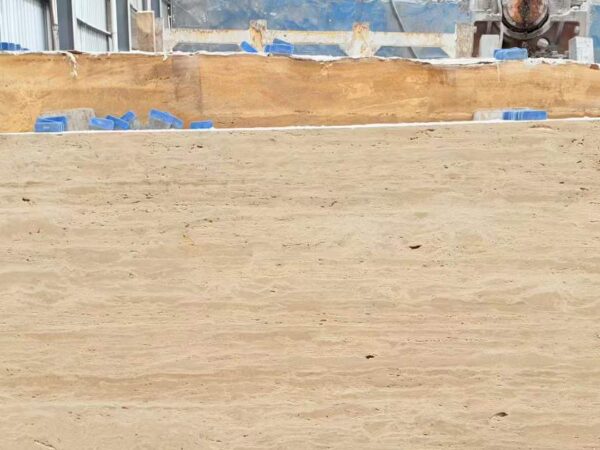
A wide travertine block showing cloudy movement and open pores across the sawn face
Raw Block

Raw Travertine Block

Split
Indicative FOB: quoted per block against block weight, block dimensions and the number of usable slabs the gang-saw recovers from it. Yield, not volume, is what a block is worth -- a 26-tonne block that yields eleven good slabs is a different product from one that yields six.View →
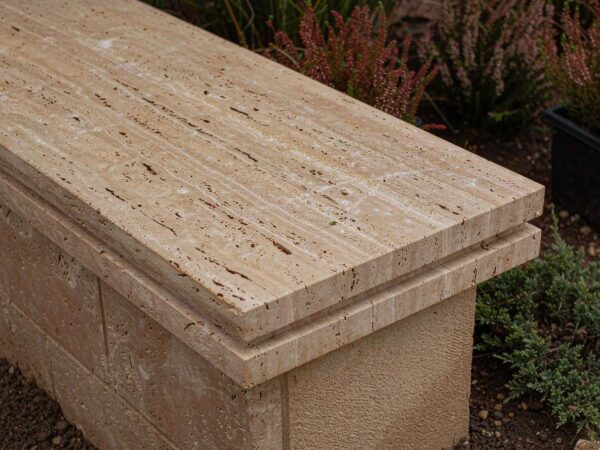
A travertine wall cap overhanging a rendered wall, drip groove underneath
Wall Cap and Coping

Travertine Wall Cap and Coping

Brushed
Indicative FOB: quoted per linear metre against length, thickness, the drip detail and whether it is matched to the wall cladding below it. A cap without a drip runs water down the face behind it, and the drip is machined rather than added.View →
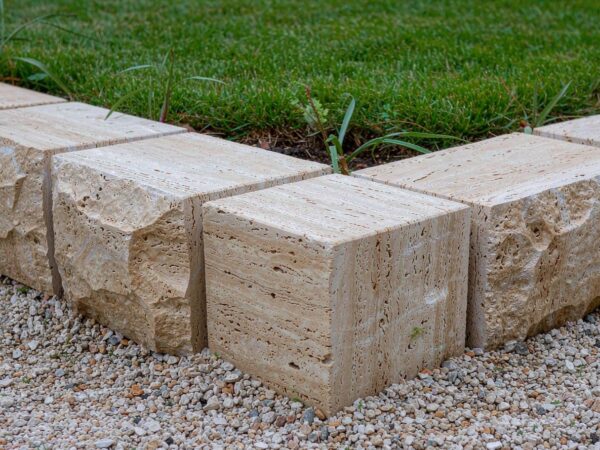
A line of travertine garden edging separating gravel from lawn
Garden Edging

Travertine Garden Edging

Brushed
Indicative FOB: quoted per linear metre against length, thickness and the edge treatment. Edging is the piece that gets handled and dropped, so the arris specification decides the price more than the finish does.View →

What we will and will not claim

Travertine is easy to oversell, because a photograph flatters it and the voids read as defects to someone who does not know the stone. These are the limits we work inside.
✓

The figures here are published ranges

Absorption, flexural strength, density: those are trade literature values for the material, not certificates issued against your order. They describe what travertine generally does. If your specification needs a tested value for the lot you are buying, ask and we will tell you honestly whether we can have it tested and what that costs in time.

✓

No photographs of material we do not have

Every image on this site has to be a photograph of stone from a lot we can actually supply. We do not use generated or borrowed imagery, and we do not show a slab that has already sold. When the catalogue opens, a photograph means stock or a lot we can hold for you.

✓

Slip ratings belong to the tile, not the stone

Travertine outdoors is walked on wet by real people. We will say honestly which formats we can get rated for which use, and where we cannot we will say that rather than let a buyer assume it. The rating you need is a property of the specific tile and its finish, and it has to come with the tile.

✓

A geological feature is not a defect

The voids, the banding, the cloudy movement: these are what travertine is. A slab without them is a different material. What we do call a defect is spalling at the edges, unfilled voids deeper than the piece can carry, and cracking through the bedding plane. We will show you where that distinction sits on your lot rather than argue about it from a photograph.

Tell us the application, not just the stone

A wall panel, a bathroom floor and a pool surround all take different travertine, and the difference is mostly the fill and the bedding. Send us the use, the format, the quantity and the destination and we will tell you which region to look at and whether it needs filling. If you already have a photograph of the stone you are chasing, send that too — it is the fastest way to narrow it down, and it is the only way we can tell you which of the four materials you are actually looking at.

Post Your Needs

Before you order

Four things about travertine specifically, that will cost money if nobody tells you and that no photograph of a travertine floor will ever show.
Fill changes the stone

The same colour, filled and unfilled, is not two finishes

Unfilled leaves the voids as they formed, so the surface reads light, open and slightly irregular, and it absorbs water at a rate that surprises people. Filling packs those voids with cement or resin and polishes the surface flat, which darkens the stone by a step or two and makes it far more consistent between slabs. It also makes it heavier and dearer, and it changes how the stone takes a sealant for the rest of its life. A photograph of a filled floor and a photograph of an unfilled floor can be the same colour and the same price band and still not be substitutable, so tell us which one you have seen and which one you want.

The face is chosen at the saw

Ask which face has been cut before you approve the slab

Travertine grows in layers, and cutting across them produces the open, horizontally lined surface the material is known for. Cutting along them produces something much finer and quieter that most people do not recognise as travertine at all. Both are correct; they are different products from the same block. The decision is made in the quarry yard when the block is opened, long before anyone sees a photograph of it, which is why the photograph you approve should always be of the sawn face and not of a slab face from a sample board.

Origin is not a delivery detail

Origin is where it was quarried, not where it was cut

A Turkish travertine block sawn in Shuitou is Turkish travertine. Any supplier who labels it "Chinese travertine" because the saw was in China is telling you something you can check and will find to be false — and a great deal of travertine is sold exactly that way. We buy from seven origins and cut in Shuitou, and we state which is which, because the question a buyer should be asking is not "where was it made" but "where was it quarried, and what does that origin mean for the stone". Turkish, Iranian and Pakistani give the strongly bedded open-vein material. Italian and Spanish give pale, fine-pored, densely polishable stone. Chinese material covers several provinces, and within it the differences between provinces are as real as the differences between countries. They take different fillers, they saw at different rates and they look different under the same finish.

Outdoors is unfilled

Filled stone eventually blisters when it wears

On an interior floor the filled surface is the better product, because it is harder, more consistent and easier to keep clean. Outdoors the argument reverses. A filled surface wears at a different rate from its own filler, and once the filler sits even slightly proud of the stone it takes the load instead of the stone and lifts in flakes. It does not fail in the first winter; it fails in the third or fourth year, which is well after the installer has been paid and the warranty has been forgotten. Unfilled, honed or brushed, with the joints detailed to drain, is the specification that lasts.