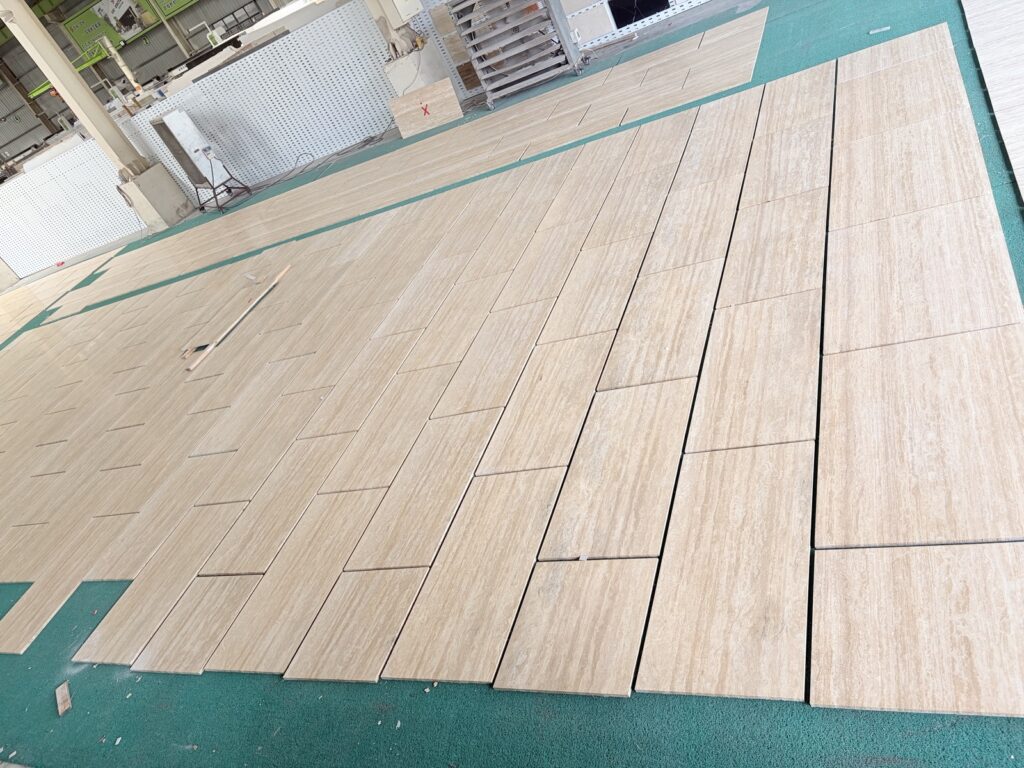
Filled Travertine Slab
| Form | Filled Slab |
| Finish | Honed |
| Color tone | — |
| Thickness | 16 / 18 / 20 / 30 mm |
| Origin | China |
| Indicative price | Indicative FOB: quoted against form, fill state, thickness and quantity. Send a thickness, a quantity, a finish and a destination port for a real figure. |
The same nominal size as the unfilled slab, and a different product: the voids are packed and the face re-ground, which flattens the tone, cuts the maintenance almost entirely, and puts a small but real weight penalty into every square metre shipped.
Specification
- Thickness: 20 mm; 30 mm for spans over 900 mm
- Slab sizes: 2400×1200 mm, 2700×1500 mm; larger on request
- Fill state: Filled and re-ground — voids packed, face refinished
- Finish: Polished or honed on the filled face
- Water absorption: Substantially lower than unfilled; still seal before grouting
- Density: 2.4-2.7 g/cm3 — at the upper end once filled
- Edge: Sawn; machined or bullnose quoted separately
How this one behaves on site
The same nominal size as the unfilled slab, and a different product: the voids are packed and the face re-ground, which flattens the tone, cuts the maintenance almost entirely, and puts a small but real weight penalty into every square metre shipped.
A filled slab is the answer to a specific problem, and it is worth being clear about which one. If the material is going to a wet room, to a pool hall, to a facade detail where the maintenance access is awkward, or to a fabricator who wants a predictable face to work with, filling solves real problems: the tone becomes consistent across the slab, water absorption drops, and the periodic sealing that unfilled travertine demands largely disappears.
The trade-offs are equally real. Filled stone is heavier to ship and heavier to handle, which shows up in freight cost and in labour on site. The fill can sink very slightly below the surface over years, and under a raking light — a low sun across a wall, an uplight at the base of a panel — that differential can show as a shadow in the voids. It is a slow, visible issue on a vertical face and a reason to hold an approval piece up to a grazing light before accepting a large filled slab for cladding.
What the fill does fix is the tone spread. Two unfilled slabs from one lot will not match; two filled slabs from one lot usually will. For a run of cladding where continuity matters, that is the deciding argument.
Ordering and supply
12-20 working days to FOB for standard forms; cut-to-size and matched sets are quoted per job. Send a thickness, a quantity, a finish and a destination port and you will have an FOB quotation, usually within three working days, with no obligation on a first shipment.